From Alpin-2 to SEYYAH: TİTRA Technology Moves Forward with a 2026 Serial Production Targets

Cem Akalın
Today, TİTRA Technology’s journey that began with the Alpin-1 Unmanned Helicopter project has evolved into a broad portfolio encompassing rotary-wing unmanned UAV systems, fixed-wing loitering munitions capable of carrying various mission payloads, FPV drones, avionics systems, and a wide range of engineering solutions. Supported by new investments, the company has become one of the prominent players in the sector, operating with a workforce of 250 personnel (75% of whom are engineers) at its 6,500-square-meter facility located in the Ankara Aerospace and Aviation Organized Industrial Zone. Following its merger with Pasifik Technology in 2024, TİTRA Technology has continued to grow with its strategic products. In addition to its headquarters in the Ankara Aerospace Specialized Organized Industrial Zone, the company operates an R&D unit at Kayseri Technokent and two hangars in the Kalecik area, within a special flight zone allocated to aviation companies by the Secretariat of Defence Industries (SSB). Within the framework of its new strategic roadmap, TİTRA Technology also aims to strengthen its presence in international markets with a new investment planned for 2026. In this context, TİTRA allocated 35-decare area in the Ankara Aerospace Specialized Organized Industrial Zone as part of its Serial Production activities.
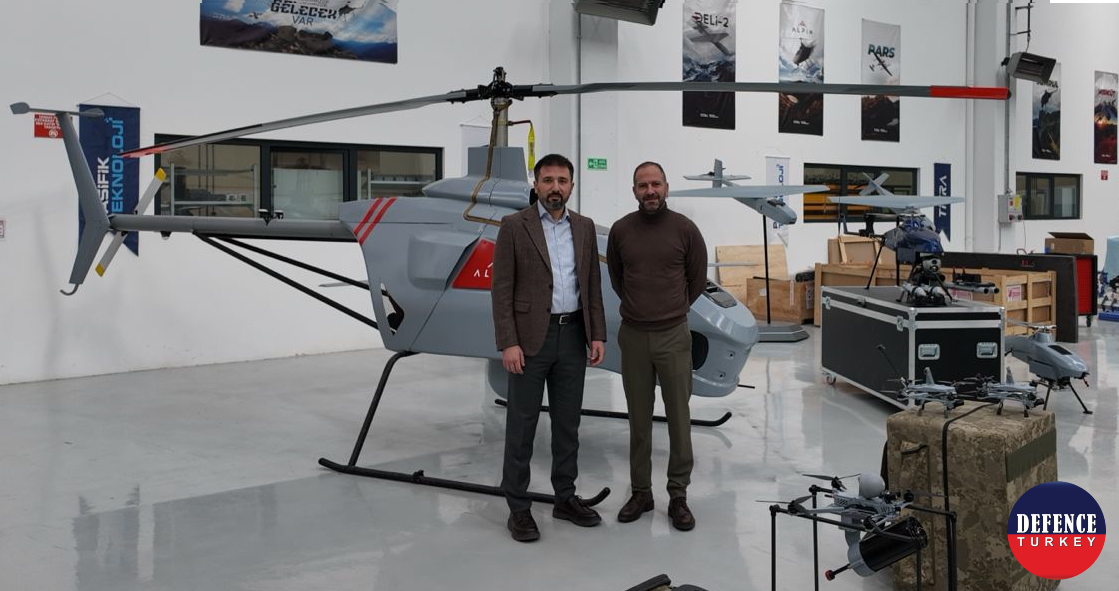
In his presentation on the company’s flagship products and ongoing development projects, TİTRA Technology Co-Founder Selman DÖNMEZ, stated that the process of producing a fully unmanned helicopter platform began with the Alpin-1 project, which first flew in 2020. Today, they introduced Alpin-2, the more advanced version of this platform, for the first time at IDEF 2025. DÖNMEZ noted: “Although the Alpin-2 version has the same payload capacity and endurance as Alpin-1, it has become a significantly more advanced platform in terms of avionics and localization rate. On the first platform, certain electronic components and software were sourced from foreign suppliers. With Alpin-2, all avionics, all electronics, and all software have been developed in-house. As a result, the Alpin-2 platform has achieved a localization rate of approximately 80–85%.”
-2.jpg)
Four ALPİN-2 Systems will be Delivered by the Year’s End
With a payload capacity of 200 kg, an endurance of 9 hours, a service ceiling of 21,000 ft, and a control radius of 200 km, the Alpin-2 provides significant logistical advantages to its users. The platform offers notable operational benefits thanks to its Anti-Jam GNSS, Controlled Reception Pattern Antennas (CRPA), GNSS-independent visual navigation capability, real-time mission planning, Identification Friend or Foe (IFF) system, SATCOM satellite communications, and VHF air-band communication systems. The Alpin-2 platform is capable of executing a wide range of missions with various payload options, including cargo, SAR radar, weapon systems, electronic warfare (EW), LIDAR/mapping, communication relay systems, and EO/IR cameras. Following the delivery of two units in 2023, it is planned that four additional platforms will be delivered by the end of this year.
Emphasizing that the Alpin-2’s 200 kg payload capacity meets a critical operational requirement, DÖNMEZ noted that the need for unmanned aerial vehicles capable of carrying heavier payloads is steadily increasing. He stated: “Turkish defense industry needs to progress toward larger unmanned helicopter platforms. A 200-kilogram payload capacity truly addresses a significant need; however, our market should not be limited to Türkiye alone. As we expand globally, we must ensure that this product becomes competitive through the technology we have developed. Especially in geographically large and densely populated regions, we observe a growing demand for unmanned vertical take-off and landing (VTOL) helicopter-type UAVs with higher payload capacities. Accordingly, we already have ongoing efforts in this direction.”
.jpeg)
ROKETSAN METE Laser-Guided Munition Integrated into the Dumrul Mini UAV
Providing information on the Dumrul Mini Unmanned Helicopter (initially developed as a training platform for the Alpin-2 and later equipped with weapon systems at the request of the Turkish Armed Forces) DÖNMEZ stated: “Dumrul, which we initially developed as a training platform for Alpin, subsequently evolved into an armed platform through weapon integration in line with the needs of our armed forces. For use in cave operations, two METE systems were integrated onto the platform. METE is a laser-guided missile developed by ROKETSAN, with an effective range of approximately two kilometers. The Dumrul platform can carry two METE micro-munitions for around half an hour of flight time. Its wind resistance, endurance, and autonomous mission execution capability make it a platform that can be effectively employed by special forces units. We are also working on concepts such as adding laser designation capability and transitioning to an internal combustion engine to increase payload capacity. Dumrul is currently in service, actively used by our armed forces, with EO and EW payload integrations already implemented, while additional requests are being addressed through ongoing R&D activities. The autopilot system is based on our own software, which also enables us to integrate our indigenous weapon systems onto this platform.”
Capable of fully autonomous take-off and landing and supporting FPV operations, Dumrul can remain airborne for more than 90 minutes with a 2 kg payload and over 60 minutes with an 8 kg payload. According to data shared by the company, it has a flight range of up to 60 km, a control radius of 20 km, and a service ceiling of 13,200 ft. Designed to carry multiple munitions and sensors for different mission profiles, Dumrul can transport two 81 mm or four 60 mm mortar rounds. The platform can also be equipped with a 40×46 mm / 40×51 mm drum-type grenade launcher, as well as two laser-guided micro-munitions. Under the contract signed with the Turkish Armed Forces, it is targeted that a certain number of Dumrul platforms will be delivered by the end of 2025.
.jpeg)
Serial Production Efforts Accelerate for Merküt FPV Kamikaze Drones
Sharing up-to-date information on the Kamikaze DELİ Product Family and the Merküt FPV Drone, both of which in development and production, DÖNMEZ stated: “In fixed-wing UAVs, our primary focus has been on the loitering munition concept. The underlying reason for this focus stems from our company’s swarm efforts. Why is the fixed-wing loitering munition and fixed-wing swarm concept so important? Characteristics such as dive methodology, dive angle, target detection, endurance, and loitering munition capability are inherent to fixed-wing UAVs. We are talking about a platform with a range of 50 kilometers, an endurance of up to 40–45 minutes, and a warhead capacity of up to 4 kilograms. Up to this 4 kg limit, we can integrate not only our own warhead but also customer-supplied warheads onto the platform. DELİ also has different variants. DELİ-2 is a platform capable of diving onto GPS-guided coordinates and is equipped with anti-jam antennas. DELİ Mini, on the other hand, is a more hand-launched concept and can also be operated using FPV goggles, making it a loitering munition with FPV capability.”
He continued: “We decided to enter the FPV drone field approximately one and a half years ago. These FPV drones, which have been extensively used in the Russia–Ukraine war and have attracted significant attention on the battlefield, are of great interest due to their cost-effectiveness and compact size. The Turkish Armed Forces have also been inducting similar drones into their inventory for nearly two years. Based on the feedback we received from our armed forces, we introduced the Merküt FPV Kamikaze Drones to the market. We developed this product in thermal camera-equipped and fiber-optic wired versions. We can say that we are the first UAV manufacturer in Türkiye to offer these capabilities. The Merküt FPV Drone has a range of 10 kilometers and is equipped with a specially designed explosive weighing approximately 600 grams, containing 1,000 fragments. The proximity sensor onboard is also critically important; the moment of detonation is decisive for the effectiveness of the explosive, and the proximity sensor minimizes the impact of operator reflexes.”
At present, with a production capacity of 100 units per month, DELİ loitering munitions have been delivered to the Turkish Armed Forces in a batch of 10 units for trial purposes, while contract negotiations for Serial Production are ongoing. For Merküt, preparations for Serial Production have already begun in anticipation of a substantial procurement.
In addition to these products, the company has recently initiated efforts to develop a VTOL system comparable to Puma. This platform, named PARS VTOL, was unveiled at the IDEF exhibition. The first flight of PARS VTOL is targeted for the first quarter of 2026, followed by the completion of qualification tests. Alongside the growth of the FPV drone market, TİTRA Technology has also introduced the KORGAN Ground Support and Surveillance Unit as another noteworthy product, particularly intended for use at base areas. This solar-powered unit enables drones to automatically take off, conduct intelligence, surveillance, and reconnaissance missions, return to the unit, and recharge autonomously.36-Month Timeline Set for the Unmanned Conversion Project of UH-1 and AB-206 Helicopters
During the press briefing, it was also announced that a contract was signed between ASFAT (General Directorate of Military Factories) and TİTRA Technology at IDEF 2025 for the conversion of Bell 206 (AB-206) and UH-1H helicopters into unmanned configurations with a payload capacity exceeding 1,000 kg. Within this scope, during the press tour, we had the opportunity to see one Bell 206 helicopter scheduled for unmanned conversion at TİTRA Technology’s hangar. As work has not yet commenced on the platform, a project timeline of 36 months has been envisaged for its transformation.
Providing information on the activities to be carried out under this project, TİTRA Technology General Manager Ekrem ÜNLÜ stated: “As you know, we have expertise in the unmanned conversion of manned systems. We initiated related work in-house around three to four years ago. Subsequently, we received requests from public authorities, and following the negotiations, we signed a contract with the 5th Main Maintenance Factory Directorate this past June. With this project, we will not only bring the old platforms in our military's inventory back into use, but also address a global market, as hundreds of these platforms are in service with armed forces worldwide. With the experience from this project, we will also introduce an unmanned conversion kit for UH-1 helicopters. This transformation will enable existing manned helicopters to be reassessed for operational and strategic purposes. TİTRA will develop all components integrated into the project using domestic engineering capabilities. The backbone of the conversion process will consist of an originally designed avionics suite, a fully indigenous autopilot system, an advanced mission computer, and ground control station software. Leveraging its production infrastructure and flight test team, TİTRA will also be able to rapidly adapt these technologies for field deployment.”
TİTRA Technology’s flagship product in the avionics domain, the Visual Navigation System SEYYAH, was also introduced during the press briefing. SEYYAH was developed as an integrated navigation solution that provides the high-accuracy data required by autopilot systems for aircraft operating in environments where GPS (Global Positioning System) signals are restricted or completely denied due to jamming and spoofing. A version of SEYYAH specifically developed for the sub-cloud UAV class can be rapidly integrated into larger aircraft operating at higher altitudes simply by changing the sensor set. The algorithms and software developed will continue to function across different platforms without requiring modification.
Visual Navigation capability, one of the most critical technologies being pursued by technology companies worldwide, is set to become one of the most decisive force multipliers in the evolving battlespace. GPS data, which all unmanned aerial vehicles rely on for positioning, is subject to intense electronic warfare interference in modern combat environments. Moreover, although positioning satellites provide openly accessible data, they also represent a critical dependency in terms of external reliance. At the beginning of the year, reports emerged indicating that national efforts to develop GPS satellites had begun, alongside ongoing RF-based alternatives for positioning. However, wherever RF signals are present, the risk of signal jamming becomes inevitable. At precisely this point, TİTRA Technology’s SEYYAH Visual Navigation System stands out as a fully indigenous solution that eliminates these vulnerabilities. Integration of the SEYYAH independent visual navigation system into all platforms as an internal project is currently ongoing.
All Civil Drones and UAV Systems to Be Controlled via Special Software with the UAV Tracking System
One of the key software solutions jointly developed by TİTRA Technology in cooperation with the Directorate General of Civil Aviation (DGCA) is the UAV Tracking System. This system will enable the centralized monitoring, route planning, and control of all civil drones and UAVs operating below cloud level within Türkiye’s borders with a single platform. Emphasizing that the software is being actively tested by the DGCA, DÖNMEZ stated that the UAV Tracking System will constitute one of the core components of TİTRA Technology’s unmanned logistics vision.
DÖNMEZ said: “This is a product with very serious export potential. It is targeted to be commissioned in the near term and expanded across all of Türkiye. When we approached the DGCA with the idea of working on civil cargo operations from a logistics perspective, they responded by proposing that, given our high level of capability, we jointly develop software to control civil air traffic for unmanned systems. That is how this project started. Efforts are ongoing to integrate the system with all civil UAV manufacturers. With this software, when you want to launch a drone, you will request permission via the DGCA application on your phone or tablet, specifying the purpose of the flight. An altitude, distance, and route will be assigned to you, and you will only be able to fly within that defined route. Through the software technology we have developed, we will be able to control your UAV via this application. The UAV will not be able to fly outside the designated route. All testing and validation activities have been completed. The project itself is finalized, and we are currently in integration stage with UAV manufacturers. Manufacturers will need to open their software interfaces; otherwise, the DGCA will not authorize flights in Turkish airspace. This technology is, in fact, one of the most critical pillars of our long-term vision. Our core objective is to develop end-to-end holistic solutions for the unmanned logistics concept, managing the entire logistics process, from producer to end user, through unmanned systems. Within this framework, the establishment of logistics hubs, the positioning of intermediate storage zones within logistics networks, and the transfer of goods from producers to these hubs via unmanned systems will play a critical role. Subsequently, an integrated structure is envisaged in which products can be delivered from main hubs to smaller local depots and directly to the end user. This approach will emerge as one of the most strategic domains within smart city and air mobility concepts, both today and in the future.”
.jpeg)
2025 to Be the Year of Deliveries, 2026 the Year of Serial Production
Underlining that 2026 will be the year of Serial Production for the company, TİTRA Technology General Manager Ekrem ÜNLÜ stated: “The year 2025 has been a year in which TİTRA Technology inducted its products into inventory. We had already inducted Alpin-1. Alpin-2 platforms are now entering inventory. Dumrul entered inventory last month with the integration of ROKETSAN’s METE laser-guided munition. We inducted the Merküt FPV Drones into inventory in their electro-optical, thermal, and wired versions. Our work on the DELİ loitering munition has also reached its final stage. In the first quarter of 2026, we will be sharing positive news with you. In other words, all the products we introduced here have entered inventory. The year 2026 will be our Serial Production year. For the Merküt FPV drone, we have a production plan of 500 units per month, but we have also prepared for a capacity of up to 5,000 units per month. We have made serious preparations for large-scale serial production. Our infrastructure is ready, and we are now awaiting high-volume orders.”
Seeking to strengthen its presence in international markets, TİTRA Technology has also completed the establishment of new offices and corporate entities abroad. In addition to offices in the United States and Dubai, the company has established a new entity named TİTRA Europa in Romania, both due to Romania’s status as a European Union member state and its geographical proximity to Ukraine. Commenting on the latest status of this initiative, ÜNLÜ stated: “With European Union countries increasing their defense budgets, Romania has allocated significant resources to defense. The company we established there does not have a foreign partner; however, after opening our office in Romania, we have begun holding substantial discussions with many European companies regarding partnerships and cooperation.”
Following the presentations and the question-and-answer session, company officials conducted a brief tour of the engineering, manufacturing, and production facilities, where participants received on-site briefings on TİTRA Technology’s products and capabilities directly from company representatives.


